Europe has a new digital border system called the Entry/Exit System (EES). It replaced passport stamps at the outer borders of the Schengen area. The Schengen area is a group of European countries with no border checks between them.
This guide is for seafarers who are not citizens of the EU, Iceland, Liechtenstein, Norway or Switzerland. It explains what changes when you join or leave a ship in a Schengen port, or fly in or out for a crew change. Facts are as of November 2026.
What is the EES?
The EES is a computer system run by the European Union. It records when non-EU travellers on a short stay cross the outer border of the countries that use it. A short stay means up to 90 days in any 180-day period. The official EU EES website explains the system.
The system started step by step in autumn 2025. Since 10 April 2026 it works at every outer border crossing point. From that date, officers no longer stamp passports.
29 countries use the EES: Austria, Belgium, Bulgaria, Croatia, Czechia, Denmark, Estonia, Finland, France, Germany, Greece, Hungary, Iceland, Italy, Latvia, Liechtenstein, Lithuania, Luxembourg, Malta, the Netherlands, Norway, Poland, Portugal, Romania, Slovakia, Slovenia, Spain, Sweden and Switzerland. Cyprus and Ireland are in the EU but still stamp passports by hand.
Does the EES apply to seafarers?
Yes, in most cases. The EU's list of people the EES does not apply to does not include ship crews. It does include crews of international trains, but not seafarers.
The Schengen border rules have some easier procedures for seafarers, for example for shore leave. But the Dutch law firm Maes Law, which advises shipowners, says these do not take seafarers out of the EES.
You are not registered in the EES if you hold a residence permit or a long-stay visa (often called a D visa) from a Schengen country. Some other groups are also outside the system, such as family members of EU citizens who hold an EU residence card.
What the border officer records
Your passport or seaman's travel document details.
The date and place of each entry and exit.
A photo of your face.
Four fingerprints, if you do not need a Schengen visa. If you need a visa, only your photo is taken, because your fingerprints were already taken for the visa.
Any refusal of entry.
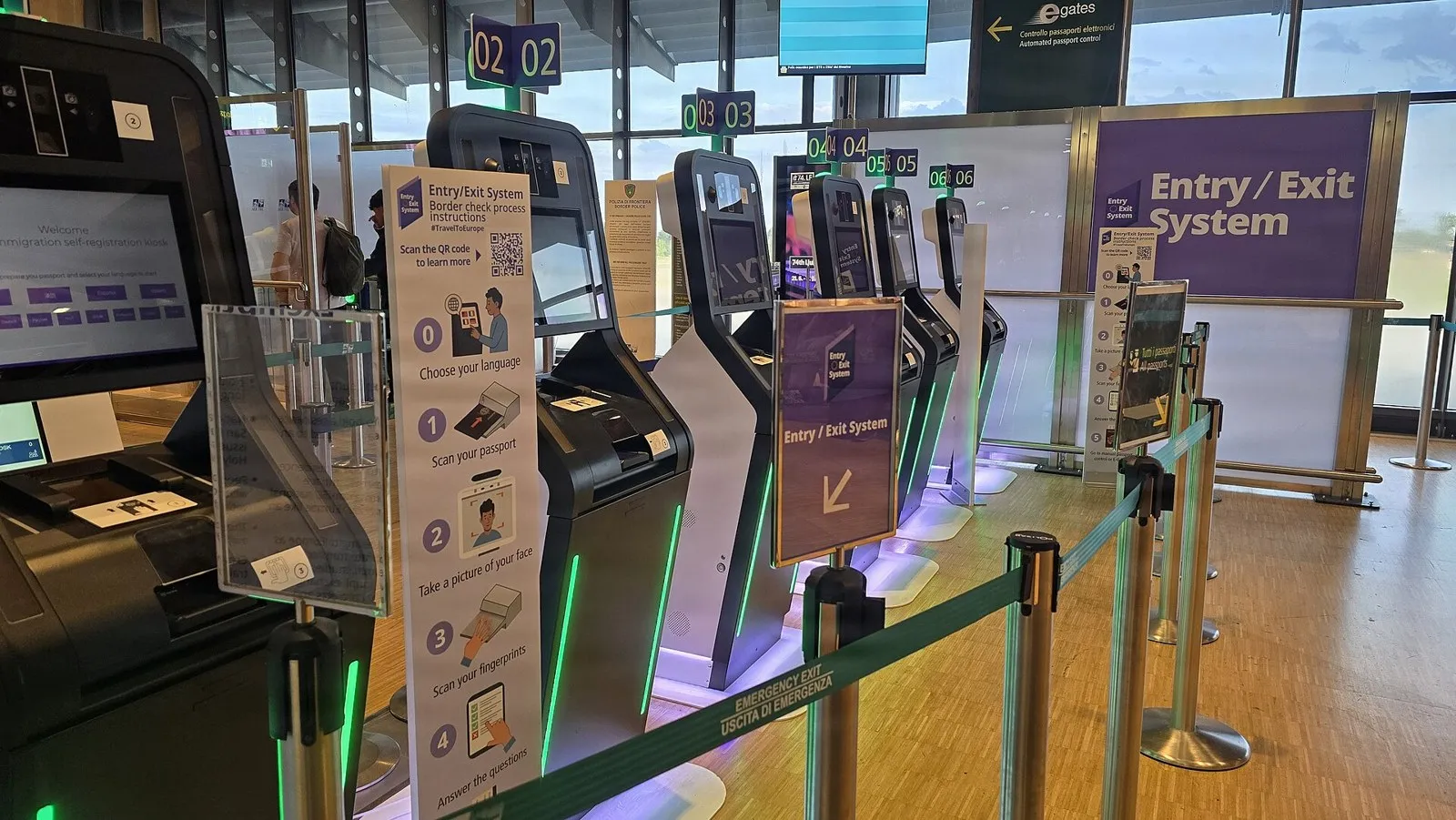
Some borders have self-service machines where you scan your passport, take a photo and scan your fingerprints before you see the officer. To use them you need a biometric passport, which has a chip. Non-biometric passports are still accepted at the officer's desk.
How the 90-day count works
The 90 days in any 180 days are counted together for all EES countries. Days in Spain, Germany and Italy all add up to one total. The EES now counts these days for you, from the entry and exit records.
This matters for crew who travel through Europe often, or who wait in a port for a long time before the ship sails. If you have already used 90 days, you will be refused entry at the border.
When does a seafarer 'exit' at a ship?
Joining a ship in a Schengen port does not always count as leaving Schengen. In 2020 the EU Court of Justice ruled on crew joining a ship that was moored for a long time in Rotterdam (case C-341/18). The court said the exit stamp should be given only when the master tells the authorities that the ship is about to sail. Maes Law says the same now applies to the exit record in the EES.
Maes Law says some countries turn this into a 10-day rule. The Netherlands does this. According to the firm, Italy applies the rule strictly and may ask ships to leave Italian waters within ten days. It says France and Spain do not follow that line. There is no common practice yet, so ask the ship's agent in each port. The firm's article on six months of EES for crew gives more detail.
How to check how many days you have left
The EU has a free online tool called Check how long you can stay. It shows if your entry is allowed ('OK' or 'not OK') and how many days you still have. You need:
the EES country you are in or want to visit;
the type and number of your travel document;
the three-letter code of the country that issued it, for example PHL for the Philippines or IND for India;
your planned arrival date, departure date, or both.
Know the limits of the tool. It does not count any stay that began before 10 April 2026. It can only use what was recorded. If your exit was never recorded, the system may think you are still in Schengen. Then it shows too few days, or even an overstay that did not happen. You can also ask the border officer how many days you have left.
What to do if your record is wrong
A record can be wrong. For example, an exit may be missing, or you may have two files. The Dutch border police (Royal Netherlands Marechaussee) explain on their page about wrong EES records that this can block automatic gates and give a wrong day count.
Write to the authority of the country where you last entered or left Schengen. If you have not been to Schengen since 10 April 2026, write to the country you plan to visit. The EU publishes the [contact details of each country's EES authority]({CONTACT}).
Ask for access to your data and for the wrong data to be corrected or deleted. You have this right under EU law.
Send a copy of your passport and proof of your real travel: flight tickets, boarding passes, your sign-on or sign-off papers, or other documents.
Expect to wait. The Marechaussee says it may take up to 45 days to decide.
Act quickly. A recorded overstay can count against you in later visa applications. In some cases a person who overstays gets a return decision and an entry ban for the whole Schengen area. The EU says such a ban should in principle not be longer than five years.
What about ETIAS?
ETIAS is a separate online travel permit for people who do not need a Schengen visa, for example British or American citizens. It will cost 20 euros. As of November 2026 it is not working yet, and nobody can apply. The official ETIAS website says the EU will announce the start date several months before.
What to do now
Keep your own record of every date you enter and leave Schengen. Count your 90 days yourself.
Keep proof of each exit: boarding passes, the crew list, and sign-on or sign-off papers. Keep them for at least a few years.
Check your remaining days with the EU tool before a long contract or a long wait in a European port.
If the tool shows something wrong, ask for a correction at once. Do not wait for your next trip.
At airports, allow extra time. Maes Law says waits of up to five hours were reported at some airports in summer 2026.
Crewing managers: plan crew changes in Italian ports with the ship's agent, and check each crew member's days before travel. Our guide to shore leave and crew changes in Indian ports covers crew rules in India.
Looking for work on ships trading to Europe? See the external vacancies collected on Crewboard. For official help lines and document checks, see Crewboard's useful links for seafarers.
Cover photo: Spanish police and officials at the presentation of the new Entry/Exit System border control at the Port of Santander, Spain, on 16 September 2026. Self-service machines stand on the left. Photo: Puerto de Santander/Wikimedia Commons, CC BY 3.0 (cropped).
Sources: European Union: What is the EES?, European Union: To whom does the EES not apply?, European Union: FAQs about EES, European Union: Check how long you can stay (EES online tool), European Union: EES contact details for data protection matters, Royal Netherlands Marechaussee: Incorrect or missing registration in the Entry/Exit System (EES), European Union: official ETIAS website, Court of Justice of the EU, judgment of 5 February 2020, case C-341/18, Maes Law: Six months of EES: what digital border control means for third-country national crew (3 Nov 2026).
How we choose, write and correct our articles: editorial policy.