A 31-year-old seafarer from the Philippines was taken off a bulk carrier near Gqeberha, South Africa, on Tuesday, 27 October 2026. He had a medical problem. He was taken to hospital in a stable condition and is recovering.
The rescue was done by the NSRI (National Sea Rescue Institute), South Africa's volunteer sea rescue service. Mark Dawson, the commander of the NSRI station in Gqeberha, described it in a statement. The local news site MyNMB published the statement on 29 October. The NSRI did not name the ship or the seafarer.
What happened
At 16:58 on Monday, 26 October, the NSRI's emergency centre told the Gqeberha crew to get ready. The MRCC (Maritime Rescue Coordination Centre) had asked the ship to turn back. The ship was about 150 nautical miles east of Gqeberha, in the open sea.
The plan was to take the seafarer off the ship near the port early on Tuesday morning. Gqeberha was earlier called Port Elizabeth, and the port still has that name.
At 05:25 on Tuesday, the NSRI rescue boat Bay Guardian left the base. On board were NSRI rescue crew trained to move patients from ships, and a government paramedic. They met the ship in Algoa Bay, the large bay off Gqeberha.
Two rescuers and the paramedic climbed on board the ship. The paramedic treated the patient together with the ship's medical crew. Then the patient was put in a harness and safety gear. He was moved onto the rescue boat, and the rescuers followed.
The rescue boat brought him to the NSRI base. An ambulance took him to hospital. The operation ended at 07:30.
Many services helped the MRCC. They included the port control of the Port of Port Elizabeth, port health, the police border unit, Telkom Maritime Radio Services, a duty doctor, the ship's master and crew, and the shipping agent.
Not a rare case
The NSRI in Gqeberha often takes sick seafarers off passing ships. In February 2026 it took a 50-year-old Filipino crewman off a bulk carrier. In July 2026 it evacuated a 37-year-old Filipino seafarer, also from a bulk carrier in Algoa Bay.
Bay Guardian is a rescue boat 14.8 metres long that turns itself upright if it capsizes. It can work up to 50 nautical miles from the coast, the NSRI says. That is why ships far out at sea are asked to come closer first.
What crews can do if someone falls ill at sea
Ask for medical advice by radio early. Do not wait until the patient is very ill. In this case, a duty doctor on shore helped with the operation.
Write down the patient's age, symptoms, medicines given and the times. Give this to the doctor and to the paramedic.
Expect the ship to change course. A rescue boat or helicopter has a limited range, so the ship may need to come closer to land.
Get the boarding point ready: a safe pilot ladder or combination ladder, good light, and a lee (shelter from wind and waves) if the master can make one.
Pack the patient's passport, seaman's book, medicine list and a small bag of clothes before the rescue boat arrives.
Follow the instructions of the rescue crew during the transfer. They decide how to move the patient safely.
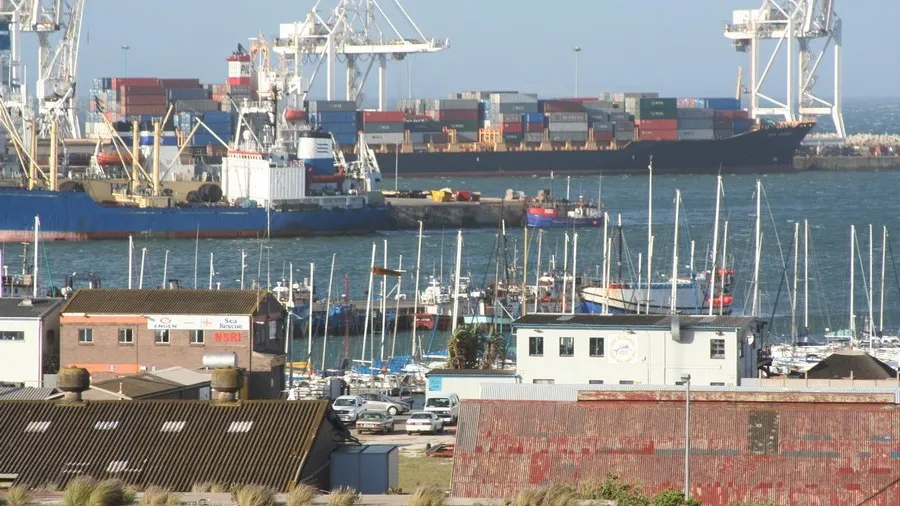
Cover photo: Part of the harbour of Port Elizabeth (Gqeberha), South Africa, in December 2005. A building with an NSRI Sea Rescue sign is on the left, with a container ship and a general cargo ship behind. Illustrative photo, not the ship in this story. Photo: Frans-Banja Mulder/Wikimedia Commons, CC BY 3.0 (cropped).
Sources: MyNMB, 29 Oct 2026: Filipino seafarer evacuated (statement by NSRI Gqeberha station commander Mark Dawson), NSRI, 16 Feb 2026: Two medical evacuations for NSRI Gqeberha, NSRI, July 2026: NSRI Gqeberha medical evacuation of a seriously ill seafarer on 20 July, NSRI, May 2025: NSRI blesses new Gqeberha offshore rescue craft Bay Guardian.
How we choose, write and correct our articles: editorial policy.