The Philippine maritime authority MARINA is looking at a new idea for cadets. Some hours in a ship simulator could count as part of the sea time needed for a first officer certificate. MARINA presented a study on this at a research forum on 9 November 2026.
No rule has changed. MARINA has not approved any change to sea-time rules and has not given a timetable, Splash247 reported on 11 November. Today, cadets still need their full sea service on a real ship.
What the study is about
The study was written by the Research and Development Division of MARINA's STCW Office and is dated June 2026. You can read the full MARINA study on the STCW Office website. It looks at deck cadets who want to become Officer in Charge of a Navigational Watch (OIC-NW). This is the first certificate for a deck officer, under STCW regulation II/1.
For this certificate, a cadet needs at least 12 months of approved sea service. It is recorded in a Training Record Book (TRB). At least 6 of these months must be bridge watchkeeping under a master or a qualified officer. In the Philippines, students can also take the route of 36 months at sea as a rating.
STCW allows other ways of training if they give the same level of skill. This is in Article IX of the convention, called "Equivalents". The study asks if simulator training could use this rule in the Philippines.
Why MARINA is looking at it
Many Filipino cadets cannot find a ship for their onboard training. MARINA asked maritime schools about this. Of the 78 schools that offer the deck officer degree, 33 answered the survey between February and March 2026.
The schools said there are too few cadet places on ships. Cadets also wait a long time, pay high costs and face slow paperwork. Some cadets finish their time at sea with parts of the TRB still empty.
The tasks most often left unfinished were these:
Using ECDIS (electronic charts), radar, ARPA (radar plotting) and GMDSS radio equipment. Some ships do not have the equipment in the TRB.
Passage planning, position fixing and work with nautical publications.
Cargo work, hatch covers, cranes and stability.
Bridge watchkeeping and emergency procedures.
What other countries do
The study says some countries already let a small part of sea service come from approved simulator training. The United Kingdom allows up to 2 months, and the Netherlands up to 60 days. The United States allows up to 30 days, and Finland up to 1 month.
In the UK, simulator time can never replace the 6 months of real bridge watchkeeping. The simulator must be approved and must include radar, watchkeeping and ECDIS training.
The IMO is also reviewing the whole STCW convention. According to the study, an IMO working group agreed in March 2026 on a possible limit. Simulator training could replace at most 3 months of sea service. The 6 months of supervised watchkeeping on board would stay. This is not yet an IMO rule.
What the study recommends
Any change should be small. It should not replace supervised bridge watchkeeping on a real ship.
Simulators could help with the skills cadets often miss, such as ECDIS, radar and passage planning. Cargo work still needs a real ship.
Only approved schools with full-mission simulators and qualified instructors should offer it. A full-mission simulator is a complete bridge copy with screens all around.
MARINA should do more pilot studies first. It should also follow the IMO review of STCW.
Shipping companies and schools should still find more real cadet places on ships.
The forum also had three other studies, the Philippine News Agency reported. They were about skills for autonomous ships, local jobs for senior high school maritime graduates and "green" artificial intelligence.
What it means for cadets and schools
Nothing changes now. You still need the full 12 months of approved sea service, including 6 months of bridge watchkeeping. Simulator hours do not count as sea time in the Philippines today.
Be careful with promises. A school or agent may say a course will "replace" sea time. Ask them for the MARINA circular that allows it. Without one, it does not count.
Fill your TRB on board. Ask your officers early to let you practise ECDIS, radar, GMDSS and passage planning. Get each task signed when you do it, not at the end.
Use simulator courses for practice. They can still help you learn before you join a ship. They just do not count as sea time.
Watch for official news. Any change would come from MARINA in a new circular. Check the MARINA STCW Office website.
See Deck Cadet salaries on Crewboard and current Deck Cadet vacancies. You can also read our post on the plan for 150,000 more Filipino seafarers by 2030.
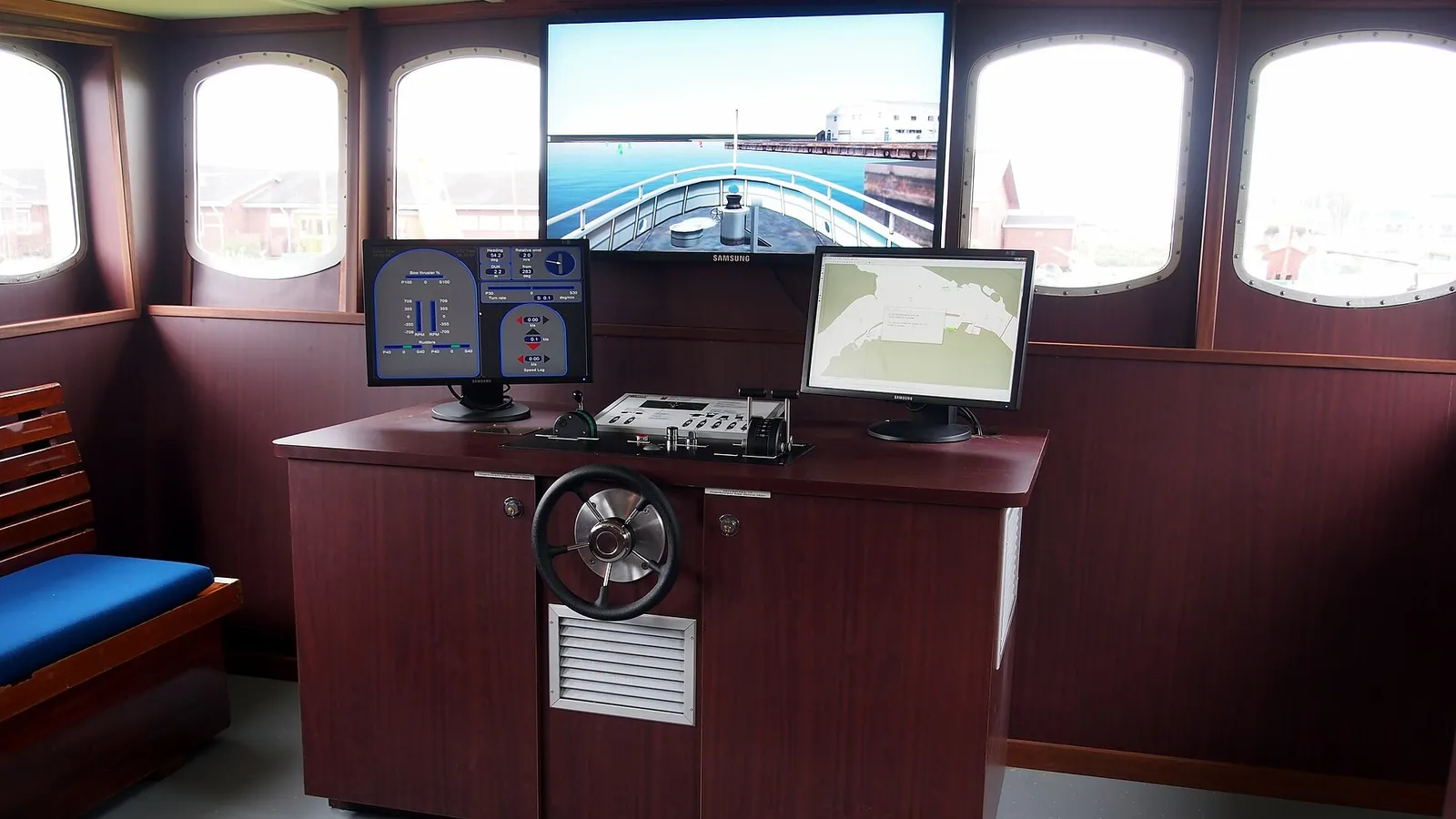
Cover photo: a small ship bridge simulator with a steering wheel and screens at the Aalborg maritime museum, Denmark, June 2013. Illustrative photo. Photo: Alf van Beem/Wikimedia Commons, CC0.
Sources: MARINA STCW Office: Exploring simulator-based training as partial substitute for seagoing service under STCW Regulation II/1 (June 2026), Philippine News Agency: MARINA holds forum on seafarer training for AI, autonomous ships (10 Nov 2026), Splash247: Philippines explores simulator alternative to sea time (11 Nov 2026).
How we choose, write and correct our articles: editorial policy.